Pages

Showing posts with label Whites Creek. Show all posts

Sunday, December 27, 2020

Case of the Mysterious Insect


On the morning of December 24th I saw something in the backyard that looked like the biggest Stick Insect ever. It was on top of some containers that stood in a bucket of water. My first impression was: there's a Stick Insect drinking. But on looking closer, I thought: maybe it isn’t a stick insect. It had the general shape of one: an elongated midsection topped by a roundish ‘head’, and a trailing ‘tail’ or ‘legs’. But I wasn’t sure. It looked more like actual wood (not fauna mimicking flora) -- with no apparent eyes, nor proper legs. I touched it slightly and it did seem to move, kind of freaking me out. Wanting a second opinion I went and called to my partner to have a look.

My partner thought the same as me, a stick insect-but not a stick insect. He touched it gently and it didn’t seem to move. I then picked it up and examined it. While it wasn’t exactly an insect, it wasn’t a pure stick either. Its ‘body’ was made of tiny twigs almost like pine needles, sort of cemented together with a kind of mud. The ‘head’ was of fluffy, woolly material. Something had ‘constructed’ this thing. Did it come from a bird’s nest? I left it on the table and went out.

I walked along Hawthorne Canal looking for wrens and Willie Wagtails (saw some). Was also pleased to see a lot of butterflies, several kinds. Vibrant blue ones with black edges, and a huge, mostly-black one that flew fast and could be mistaken for a bird flying past; some had orange-with-black lined wings, reminding me of Monarch butterflies. I was happy that Insect Armageddon, which people talked about last year, was maybe slowing this year, with our increased rain possibly restoring some habitat.

Recently I’d seen four different types of dragonfly at Whites Creek wetland. Smallish dragonflies with pale blue bodies; a bright, chili-red bodied one; ones that were dull brown except their ‘faces’/ front of their heads which were electric turquoise; and lastly, big, double-sized brownish-gold dragonflies.

It’s also been a bumper year for crickets and cicadas, lots of people in various neighbourhoods and places have remarked. To me the cicadas sound like they’re all playing the banjo, except for the ones that are playing kazoos – cacophony but the vibrations can really fill your head and heart like ‘Om’.

When I got home from the butterfly walk, I went to check on the mystery ‘stick’. I’d begun thinking it might be a butterfly chrysalis and I should put it into the garden or in a tree, from where it had maybe blown down. I looked at the table, but the stick was gone – where now? It was vertically perched on the wall, with a kind of caterpillar sticking out the ‘head’ end. Wow. And it was climbing up.

I studied it for a while. The caterpillar was a dark orange colour with black rings. Its little head was moving around, and I could see three pairs of legs. This caterpillar-front was pulling the back, stick section, along. It seemed to be climbing the wall, but wasn’t making much progress. I started to worry about it. The moving head and mouth seemed like they were demonstrating hunger. After a while I gently tried to move it, thinking I could put it in a tree, where I thought it would be happier and could eat. But it wouldn’t come off the wall! Its little hands/legs seemed to be kind of stuck to the wall.


I took some pictures then went inside to get a ruler to show some scale, and to see how big it was. When I came back it had vanished completely.

I googled a description of it and found it’s called a Case Moth or Saunders Moth. It is a creature that carries its ‘mobile home’ with it. I read that the female, which can live for two years, doesn’t leave the case, and only the male grows wings. The creatures spin a sort of ‘silk’ which explained the woolly-looking top of the case. The caterpillars can go back inside the case if they feel they need to, and can re-close the opening. The sticky silk they can make was probably how its legs were sticking to the wall. Case moths are around 15 cm long. Even though I hadn’t been able to put a ruler next to it, me and my partner estimated the one we saw was 15 cm exactly (approx. 6 inches).

The short amount of information I found didn’t really explain it for me. It was the weirdest, most prehistoric looking insect I’ve ever seen. I never saw one before and doubt I’ll see one again. When it left I felt like it could have easily vanished into outer space, or returned to 3000 years in the past where it came from.

Some people tell a story that on Christmas Eve, animals can talk. On this day it seemed true, but I couldn't be sure what the creature was saying.


Friday, August 23, 2019

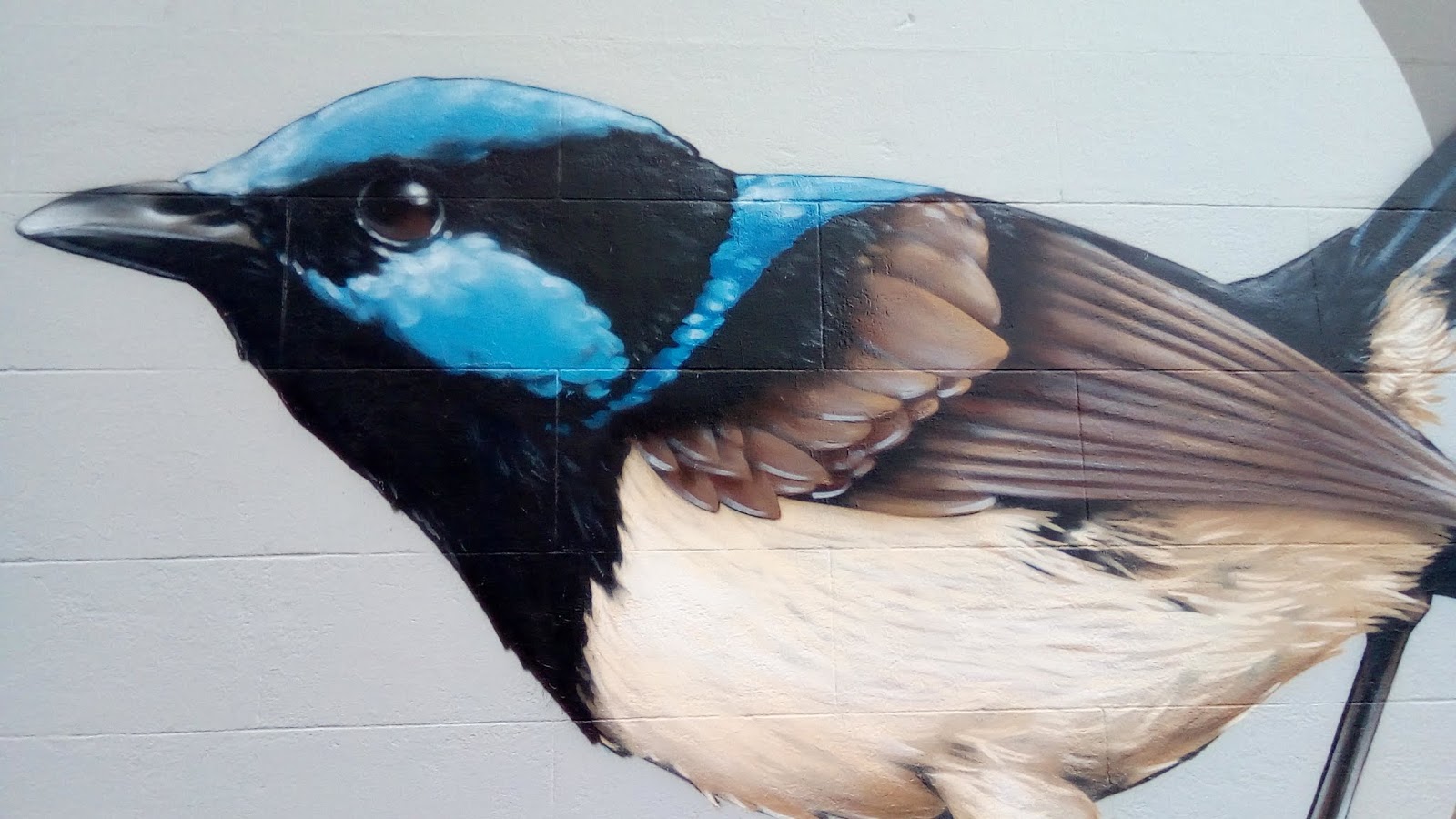
Project Wren


Mural Painting by Thomas Jackson 2019


Sydney’s Councils are valiantly trying to save Australia's beautiful blue, tiny birds.


Sydney City Council has plantings in the Blackwattle Bay area to encourage Superb Fairy Wrens (great title for a tiny bird) and New Holland Honeyeaters (black & white markings with bright yellow touches; small but not as small as the fairy wrens). The Glebe Society, an activist group which this year turns 50, has a Blue Wren Subcommittee. The foreshore parks are full of signs about council’s intent to create habitat… but sadly I've never seen a wren nor a New Holland honeyeater there. At the exhibition in the Tramsheds in June, I learned that in spite of their efforts, alas no wrens have been spotted in the Glebe area for several years.


Waverley Council has recently pitched a program for residents (mainly in Bronte and Tamarama), to plant yards that encourage fairy wrens. The Wentworth Courier (April 24, 2019) notes that wrens live on the cliffs in public parks (you’ve probably seen them if you’ve been on the coastal cliff walk). Some wrens and New Holland honeyeaters live in Centennial Park, so the idea is to make a plant corridor where they can live in between. Waverley's website has a page re: Bushland and Wildlife/ Living Connections.

They are offering a lecture ($5) plus plant giveaway on 10 September 2019. 

I’m not quite sure if the lecture is only for residents who live inside the target area, or for anyone. Contact Waverley council if you are interested.

Inner West Council's ‘Greenway Corridor’ along Hawthorne Canal aims to help birds, but I don’t think Inner West has a specific wren targeted outreach. The Rozelle Bay Community Native (Plant) Nursery, located in Whites Creek Valley, gave out free native plants at the council ecology festival in 2018, and hopefully they will do the same this year. Here’s the date: Sunday, 25th August 2019. 

Randwick Council conducts events about local birdlife and how to identify and encourage it. Most councils probably do – now that I’ve checked this handful of councils, I’ve been encouraged by all their stated intentions. Other information sources: websites – Birds in Backyards, and Backyard Buddies.
Native plant seedlings


The problem: moving from council’s intentions to residents’ intentions. Especially in Bronte and Tamarama, where high-cost property and renovations present ongoing environmental factors. People sometimes save a large tree, especially if they are asked to. But saving low growth has not been a priority. Low bushes are where wrens live.

Trying to ‘re-establish’ rather than save already established habitat is difficult. But I hope people get on board wherever they live, and help our little birds. If you have a dog, please don’t let it run into the bushes on the coastal or harbour walk. (And if you do plant some habitat, try to keep pets out of it.) 
Another benefit from these plants: they feed insects, which are struggling to survive. And these in turn would be a food source for the birds. It’s great to walk around in summer listening to the crickets and cicadas humming. I hear them more when passing some gardens than others, but haven’t pinpointed exactly which plants or environments they prefer.

I’ve sighted fairy wrens twice lately in the Inner West, both times on Whites Creek. 

Around six months ago in a sort of bushy patch/old garden on the Railway Parade nature strip. Then about a week ago, I was standing in a similar place looking at the canal when I heard and saw a pair of Willie Wagtails. They often live and hang out in similar places to wrens: both eat insects and live low to the ground. While watching Willie, I spotted a pair of wrens just across the water, in the bushy area that runs alongside the light rail there. This is probably a very good spot for them where no dogs can access.

But who knows if that area can protect them: the M4 West Connex continues apace, with the intention of destroying Burrawan Park (only meters away), to improve access for cars driving between The Crescent and the CityWestLink.


Friday, March 1, 2019

The First Straw


Australia Road writer’s blog


about old buildings, natural wonders, and some historical stories I can’t let go, like a dog with a bone. 


The First Straw


I walk because my life depends on it. 
I want what all walkers want. Solid streets and wide paths to plant my feet, greenery with birds and small animals, enchanting houses and colourful structures.

Previously I walked around Sydney’s East but lately I’ve been exploring the Inner West. In tree-lined cool enclaves and ancient lanes squeezed with giddy old factories and precarious terrace houses, murals catch the eye and something (the historic atmosphere, a child, or a singing magpie) is bound to touch the heart. 

Walking this morning I carried a re-usable shopping bag for the errands I had planned. And so, when I saw some stray garbage - a can here, bottle there - I started thinking, well, I could pick it up. But I really don’t want to.

In Tamarama Gully and the eastern suburbs, I used to pick up a lot of rubbish, on Clean Up Australia Day or just random Sundays. But in places like Leichhardt and Newtown, I’ve been more inclined to turn a blind eye. Strolling in a daydream this morning, I entered the grassy area alongside Whites Creek – and there I saw it: the red-striped plastic straw. 

FINE. If that’s the kind of thing that’s going to be tossed out on the creek side, I can’t ignore it.

 Photo by Mohamed Maail, on Unsplash.com

Whites Creek* has a small ‘wetland’ pocket with charming footlong turtles (30 centimetres) who rise to the surface and peer at you through the water weeds if you stand still and watch. I was planning to check them later, hoping to glimpse a foot or an edge of shell. 
Straws have been targeted lately as high priority trash. Whites Creek’s cement-lined waterway leads straight to Sydney Harbour, and from there to the ocean.

Unfolding my bag, I drop the straw in. Now I can’t relax but must stop every metre or so; finding plastic water-bottles, coffee cup lids, bottle caps, and water-bottle LABELS that have escaped their bottles. Ziploc bags, chocolate wrappers, a toothbrush, popped balloon tied to a ribbon, and Styrofoam pieces complete the stash.

I only pick up plastic – that idea started last year during a litter removal jag in Centennial Park. Glass bottles – meh. Metal cans or bottle tops – nah. These items might pose hazards, but are more ‘natural’, and can break down; they won’t join the great Pacific garbage patch one day. And they probably won’t get stuck in a sea animal’s stomach or nasal passage, or wind around its limbs. Besides, if I was going to pick up everything, I’d have to push a trolley. 


At the Great Barrier Reef two years ago, a huge sea turtle ate a wobbly white-ish jellyfish before my eyes. So I easily believe plastic looks like their food – clear or white, and flexible. The veterinarian on Better Homes and Gardens tv show,  Dr Harry Cooper, said in February that it's possible "in 40 years time there may be no sea turtles around". This is the year of the pig on the Asian calendar, but for me it feels like Year of the Turtle.

Passing the wetland later I notice part of the water surface is clear – it’s been very clogged recently – and a longneck turtle comes up to me. Its back and legs and neck are fully visible for the first time. One of its buddies swims close too - it has three normal legs and one smaller, damaged. If I can catch some straws and plastic bits before they hurt any water friends, I’ll do it. 
* Whites Creek is how it is written, even if you just want to put an apostrophe in there.

[FYI this post is not sanctioned by nor related to them]