Pages

Showing posts with label Inner West Sydney. Show all posts

Sunday, December 27, 2020

Case of the Mysterious Insect


On the morning of December 24th I saw something in the backyard that looked like the biggest Stick Insect ever. It was on top of some containers that stood in a bucket of water. My first impression was: there's a Stick Insect drinking. But on looking closer, I thought: maybe it isn’t a stick insect. It had the general shape of one: an elongated midsection topped by a roundish ‘head’, and a trailing ‘tail’ or ‘legs’. But I wasn’t sure. It looked more like actual wood (not fauna mimicking flora) -- with no apparent eyes, nor proper legs. I touched it slightly and it did seem to move, kind of freaking me out. Wanting a second opinion I went and called to my partner to have a look.

My partner thought the same as me, a stick insect-but not a stick insect. He touched it gently and it didn’t seem to move. I then picked it up and examined it. While it wasn’t exactly an insect, it wasn’t a pure stick either. Its ‘body’ was made of tiny twigs almost like pine needles, sort of cemented together with a kind of mud. The ‘head’ was of fluffy, woolly material. Something had ‘constructed’ this thing. Did it come from a bird’s nest? I left it on the table and went out.

I walked along Hawthorne Canal looking for wrens and Willie Wagtails (saw some). Was also pleased to see a lot of butterflies, several kinds. Vibrant blue ones with black edges, and a huge, mostly-black one that flew fast and could be mistaken for a bird flying past; some had orange-with-black lined wings, reminding me of Monarch butterflies. I was happy that Insect Armageddon, which people talked about last year, was maybe slowing this year, with our increased rain possibly restoring some habitat.

Recently I’d seen four different types of dragonfly at Whites Creek wetland. Smallish dragonflies with pale blue bodies; a bright, chili-red bodied one; ones that were dull brown except their ‘faces’/ front of their heads which were electric turquoise; and lastly, big, double-sized brownish-gold dragonflies.

It’s also been a bumper year for crickets and cicadas, lots of people in various neighbourhoods and places have remarked. To me the cicadas sound like they’re all playing the banjo, except for the ones that are playing kazoos – cacophony but the vibrations can really fill your head and heart like ‘Om’.

When I got home from the butterfly walk, I went to check on the mystery ‘stick’. I’d begun thinking it might be a butterfly chrysalis and I should put it into the garden or in a tree, from where it had maybe blown down. I looked at the table, but the stick was gone – where now? It was vertically perched on the wall, with a kind of caterpillar sticking out the ‘head’ end. Wow. And it was climbing up.

I studied it for a while. The caterpillar was a dark orange colour with black rings. Its little head was moving around, and I could see three pairs of legs. This caterpillar-front was pulling the back, stick section, along. It seemed to be climbing the wall, but wasn’t making much progress. I started to worry about it. The moving head and mouth seemed like they were demonstrating hunger. After a while I gently tried to move it, thinking I could put it in a tree, where I thought it would be happier and could eat. But it wouldn’t come off the wall! Its little hands/legs seemed to be kind of stuck to the wall.


I took some pictures then went inside to get a ruler to show some scale, and to see how big it was. When I came back it had vanished completely.

I googled a description of it and found it’s called a Case Moth or Saunders Moth. It is a creature that carries its ‘mobile home’ with it. I read that the female, which can live for two years, doesn’t leave the case, and only the male grows wings. The creatures spin a sort of ‘silk’ which explained the woolly-looking top of the case. The caterpillars can go back inside the case if they feel they need to, and can re-close the opening. The sticky silk they can make was probably how its legs were sticking to the wall. Case moths are around 15 cm long. Even though I hadn’t been able to put a ruler next to it, me and my partner estimated the one we saw was 15 cm exactly (approx. 6 inches).

The short amount of information I found didn’t really explain it for me. It was the weirdest, most prehistoric looking insect I’ve ever seen. I never saw one before and doubt I’ll see one again. When it left I felt like it could have easily vanished into outer space, or returned to 3000 years in the past where it came from.

Some people tell a story that on Christmas Eve, animals can talk. On this day it seemed true, but I couldn't be sure what the creature was saying.


Saturday, December 26, 2020

The First Day


During Naidoc week (a celebration of Indigenous and Torres Strait Islander people and culture), I was watching a concert on NITV. Singers performed “Aboriginal Woman”, a song written in the 1990s by Bart Willoughby, a Pitjantjantjara/ Mirning man. In this performance, a younger generation of women brought passion and joy to the song's message of resilient women living, loving, standing up for what’s right. “Aboriginal Woman, never fade away”. “Aboriginal Woman, she’s here to stay”. “Aboriginal woman, she’s the backbone of our spiritual ways”. 

I acknowledge Gadigal and Wangal elders, past, present and emerging, who lived and live in the places now called Sydney and Annandale. November 2020’s Naidoc week theme was “Always Was, Always Will Be”... from the affirmation Always Was, Always Will Be: Aboriginal Land.

The day after hearing the song 'Aboriginal Woman', and with it humming in my ears, I made myself walk to look at something I’ve been avoiding. The NSW Govt is building WestConnex, with a double-decker (two-level) freeway ramp at the harbour foreshore where Johnston Street in Annandale runs toward the water. I and many others had written to the government strenuously objecting. One concern is that the proposed roadway would block sight of the big mural along The Crescent. The delightful artwork shows natural history and First Nations people as well as urban streets and flight paths. 


Making written submissions to government is draining and time-consuming and too often results in no changes. This time the government altered their plans slightly, to address some complaints re: pedestrian and cyclist inconvenience; but the elevated ramp idea stayed in. I felt discouraged but retained some hope that the government would at least be documenting the painted local history mural on the old brick wall supporting the railway trestle. This landmark was first painted in 1980 by Rodney Monk, updated by him in 2005.* 

Recently I noticed chainlink fences around the Rozelle/ Lilyfield future ramp area, indicating work was imminent, but I dreaded to look up close.


During winter I’d become upset when walking in the area. Three separate construction projects, by three different government bodies/corporations, were taking place all at once (1- WestConnex removal of foreshore trees, and obliteration of the adjoining Burrawan Park; 2- Sydney Water ‘improvements’ to Johnstons Creek, chopping down dozens of trees, fencing off the creek and surrounding park; 3- Sydney City Council ‘improving’ Federal Park/Bicentennial Park by knocking down semi-industrial buildings fringing the park boundaries, and re-landscaping, with most grassed areas fenced off.)

How much disruption to our local place of serenity can we take? I sincerely wonder if government bodies talk to each other about these type of projects and their timing. If they purposely meant to overlap, I question if that is best for the health and mental health of our crowded urban area where people need to exercise, and like to take their dogs. (BTW Some of the park 'improvements' may turn out well, but the uncomfortable transition could be better considered by planners.)

Unfortunately during winter I allowed myself to sometimes get angry and swear out loud at what I saw and heard. So I got in the habit of staying away. I found different paths to walk, different creeks to follow. 

Area formerly known as Burrawan Park

View of brick viaduct over Johnstons Creek in calmer, less torn-up times

On this day I realised my irritations are minor compared to what some people have endured and lived through. My loyalty to history and admiration of Indigenous women drove me to check what’s become of the mural. 

In my tour Aqueducts and Viaducts of Annandale, given during History Week 2019 (and to some groups in early 2020 before Covid-19), the most important part of the story was “Bennelong and Barangaroo were here”. Literally, here, where we stopped along Johnstons Creek at the reconstructed wetlands to think deeply about the Wangal and Cammeraygaleon couple who fished, or walked, in Sydney wetlands and foreshores.

Tree near Warren in western NSW showing its scar where thick bark for a canoe was cut out.

Barangaroo: think of her in a canoe, singing; fishing with a line she made and a beautiful hook she created from a shell. (Men’s fishing method was to use a spear, while standing on shore.) Women would light a fire in the canoe, cook a fish they caught, sometimes while breastfeeding a baby, calmly balancing with other small children onboard. The mural depicts a scene something like this, and I feared it might no longer be visible.

Remember also Bennelong, Barangaroo’s husband, who had the misfortune to be violently kidnapped by Governor Phillip’s military men. Think about Lieutenant -- later Major -- George Johnston, who came to live on this land he re-named Annandale, with his partner Esther Abrahams. He boasted that he was the first person to step ashore from the First Fleet in 1788. He wanted fame but probably came closer to being infamous.

Barangaroo was a mature woman. Bennelong was her second husband, and she was his second wife. The First Fleet diary writers like Watkin Tench and David Collins wrote a lot about her. She was a fighter, a justice warrior, and she was unafraid. Grace Karkens writes that “When the whites invited her to watch a flogging, she became disgusted and furious, and tried to grab the whip out of the flogger's hands.”**

Rounding the corner where the mural comes into view… I see that some of it is still visible. I don't know if the ramp and fencing here are temporary or the final configuration. But at least the Aboriginal woman can be seen, albeit behind steel wire. May the image of her never fade away.


Footnotes:

*The NSW Govt promised they would document and archive the mural prior to current construction works. Inner West Council website has an article from 2018 offering good quality photographs of the painting. Leichhardt Council, folded into Inner West, had originally commissioned the artwork. A few years ago they proposed Heritage Listing it.

**Barangaroo and the Eora Fisherwomen | The Dictionary of Sydney by Grace Karskens 2014, [viewed online 24/12/2020.] 

Wikipedia’s page for Barangaroo also says Watkin Tench described how “a convict was flogged in front of an audience of Aboriginal people, for stealing from them. Barangaroo was angry, and menaced the man performing the flogging with a stick.” [Viewed online 24/12/2020.]


Friday, August 23, 2019

Project Wren


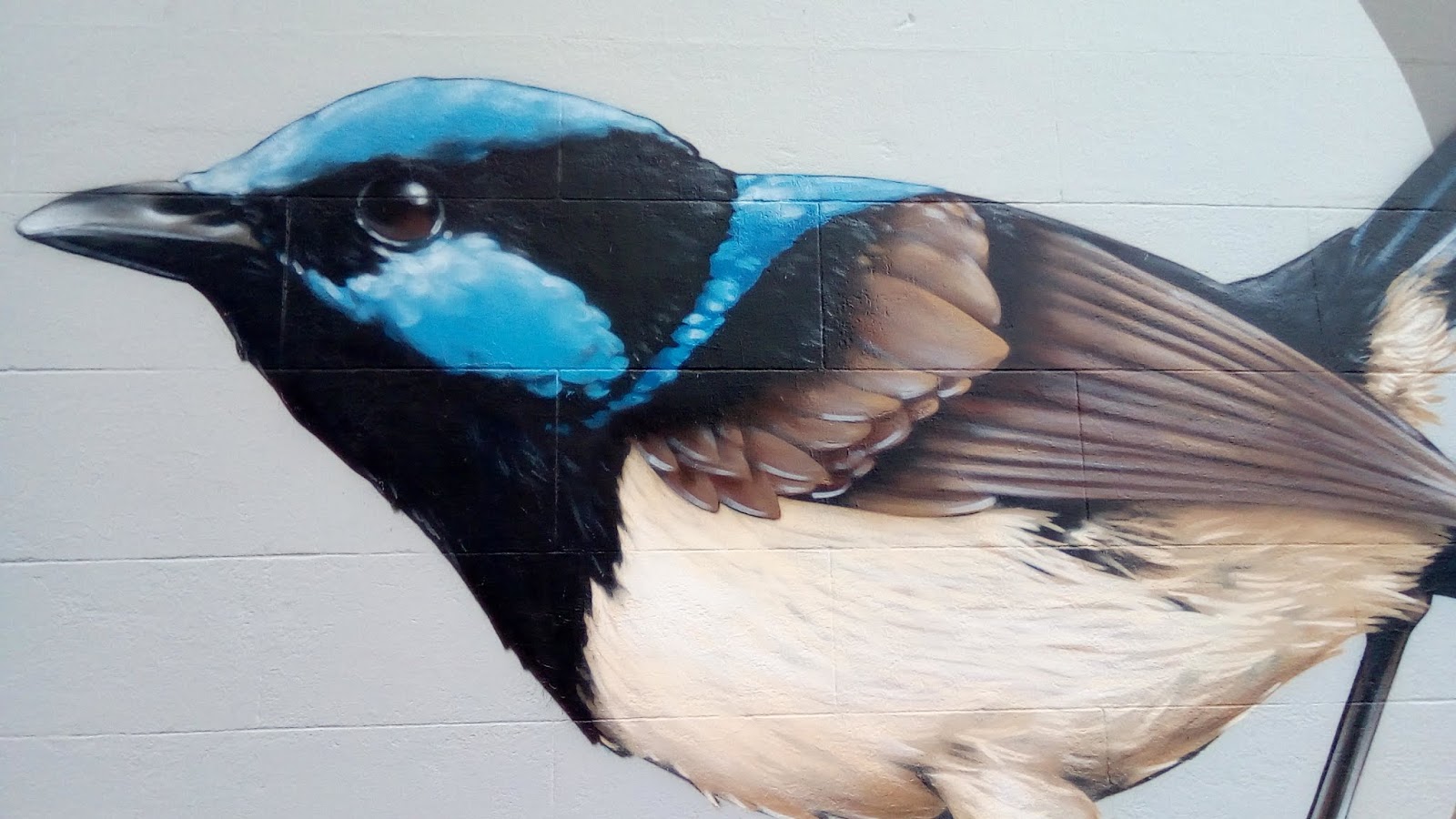
Mural Painting by Thomas Jackson 2019


Sydney’s Councils are valiantly trying to save Australia's beautiful blue, tiny birds.


Sydney City Council has plantings in the Blackwattle Bay area to encourage Superb Fairy Wrens (great title for a tiny bird) and New Holland Honeyeaters (black & white markings with bright yellow touches; small but not as small as the fairy wrens). The Glebe Society, an activist group which this year turns 50, has a Blue Wren Subcommittee. The foreshore parks are full of signs about council’s intent to create habitat… but sadly I've never seen a wren nor a New Holland honeyeater there. At the exhibition in the Tramsheds in June, I learned that in spite of their efforts, alas no wrens have been spotted in the Glebe area for several years.


Waverley Council has recently pitched a program for residents (mainly in Bronte and Tamarama), to plant yards that encourage fairy wrens. The Wentworth Courier (April 24, 2019) notes that wrens live on the cliffs in public parks (you’ve probably seen them if you’ve been on the coastal cliff walk). Some wrens and New Holland honeyeaters live in Centennial Park, so the idea is to make a plant corridor where they can live in between. Waverley's website has a page re: Bushland and Wildlife/ Living Connections.

They are offering a lecture ($5) plus plant giveaway on 10 September 2019. 

I’m not quite sure if the lecture is only for residents who live inside the target area, or for anyone. Contact Waverley council if you are interested.

Inner West Council's ‘Greenway Corridor’ along Hawthorne Canal aims to help birds, but I don’t think Inner West has a specific wren targeted outreach. The Rozelle Bay Community Native (Plant) Nursery, located in Whites Creek Valley, gave out free native plants at the council ecology festival in 2018, and hopefully they will do the same this year. Here’s the date: Sunday, 25th August 2019. 

Randwick Council conducts events about local birdlife and how to identify and encourage it. Most councils probably do – now that I’ve checked this handful of councils, I’ve been encouraged by all their stated intentions. Other information sources: websites – Birds in Backyards, and Backyard Buddies.
Native plant seedlings


The problem: moving from council’s intentions to residents’ intentions. Especially in Bronte and Tamarama, where high-cost property and renovations present ongoing environmental factors. People sometimes save a large tree, especially if they are asked to. But saving low growth has not been a priority. Low bushes are where wrens live.

Trying to ‘re-establish’ rather than save already established habitat is difficult. But I hope people get on board wherever they live, and help our little birds. If you have a dog, please don’t let it run into the bushes on the coastal or harbour walk. (And if you do plant some habitat, try to keep pets out of it.) 
Another benefit from these plants: they feed insects, which are struggling to survive. And these in turn would be a food source for the birds. It’s great to walk around in summer listening to the crickets and cicadas humming. I hear them more when passing some gardens than others, but haven’t pinpointed exactly which plants or environments they prefer.

I’ve sighted fairy wrens twice lately in the Inner West, both times on Whites Creek. 

Around six months ago in a sort of bushy patch/old garden on the Railway Parade nature strip. Then about a week ago, I was standing in a similar place looking at the canal when I heard and saw a pair of Willie Wagtails. They often live and hang out in similar places to wrens: both eat insects and live low to the ground. While watching Willie, I spotted a pair of wrens just across the water, in the bushy area that runs alongside the light rail there. This is probably a very good spot for them where no dogs can access.

But who knows if that area can protect them: the M4 West Connex continues apace, with the intention of destroying Burrawan Park (only meters away), to improve access for cars driving between The Crescent and the CityWestLink.


Monday, July 1, 2019

History Week will be 31 August - 8 Sept 2019

Annandale Aqueducts and Viaducts

A walk/talk illustrating this year's History Week theme of 'Memory and Landscapes'

90 minute tour given by author of Australia Road blog (Robin). The Walk/Talk will be given on two dates (same walk & talk each time).


Tour Dates, choose one:
Wednesday, 4 September 2019
10.30 am to 12 noon
or
Saturday, 7 September 2019
10.30 am to 12 noon

Location: Smith, Hogan and Spindlers Park
Taylor Street, Annandale

Meet under the arches of the white-coloured aqueduct, half-way into the park. (Approx. half a kilometre from Light Rail Station Jubilee Park.)

We'll take a look at this landscape where classical arches add beauty. The park's landscape has transformed many times in the last 250 years. Waterways used by Indigenous residents were taken over by industry; today you can see ecosystem restoration. We'll hear about people who devoted themselves to influencing the landscape here.


History Week is sponsored by the History Council of New South Wales

If you have a question you can leave a comment below and I'll get back to you. Or check the History Council's History Week website listings. 

Friday, March 15, 2019

Paved Paradise

It isn't pretty but it's a subject I looked at this week: cement. Mostly it's not very aesthetic to look at, but sometimes it can be pleasing to the eye, like the arches on the Annandale aqueduct.


I found out more about some wayfinding aids (mentioned last week in 'Australia, Street'). When town planners 'set them in stone' on concrete footpaths, they clearly thought the designations would last forever. Little did they know the 'municipality' and council areas would be constructed, deconstructed and amalgamated many times.
  
A blink in time: 1906 to 1948. But the footpath sign lives on in 2019.
'Municipality of Petersham' was created in 1906, born out of the 'borough' created in 1871 from townlets Stanmore, Petersham and others. The 'municipality' lasted until 1948, when it merged and fell under the name of Marrickville Municipality. They were happy enough together for nearly 70 years - until 2016 when the 'forced merger' with two other municipalities created Inner West Council.

I'm trying hard not to discuss 'politics' in this blog. But it wants to creep in.

Back to concrete 'standing the test of time'. Its discoverers knew that. It is similar to ceramics: if you use very high heat to cook certain materials - types of mineral dust - they change and can be bound together almost forever. In some archaeological sites, pot sherds or shards are found more than anything else. 


The Annandale aqueduct has a plaque explaining it was made in 1896 from a revolutionary material: reinforced concrete. A royal commission investigated its use; and the builders were forced to post a large 'surety' and guarantee maintenance for three years. More than 120 years later it's fine.

At a California mission site I worked at years ago, we found fired-clay roof tile pieces by the bucket load. 

(The adobe blocks which made the buildings were only sun-dried, and 'melted' when exposed to rain.) Fragments of plates also made up great quantities, especially from dates closer to the present; the California Indians who lived in the area and were recruited to the mission did not make pottery as a rule since they had an incredible range of baskets that could cover almost any task.

I went down a research hole to understand the origins of pottery and porcelain. Travelling to England's Staffordshire District I visited pottery factories and the home of Wedgwood. Even while in England seeds of doubt were being sown, about whether this was the job for me. I thirstily went to exhibitions and free archaeology lectures. Sitting in one lecture about medieval shoes... the speaker droning about minutiae... something snapped in me and I lost momentum. I don't doubt the usefulness of all kinds of arcane subjects; I just found that even I had a limit.


Bowls and plates made from pottery or china last a very long time, or at least pieces of them do.
Photo by Louis Hansel on Unsplash.com


Another limit I brushed against was digging up bones. Some archaeologists dream of a day they could be privileged to uncover a human skeleton. I dreaded it, and luckily was never asked to do so. I believe in science but also feel unseen connections from past to present and person to person and I didn't want to cross that. I did shake a lot of bone fragments through screens, and tried to learn from experts to identify them, so as not to unwittingly handle human ones. (So many cow bones, fish bones, deer bones, bird bones.) 

I love handling a cool stone arrowhead, or glassy obsidian flake, or smooth grinding stone as much as anyone. But over time for a number of reasons I veered away from archaeology and into 'interpretation'. There is plenty of stuff already dug up, and more to come, and maybe I could be of use helping spread understanding of material objects.


This homeowner built their front fence from homemade concrete
 instead of buying shaped sandstone forms and pillars like everyone else in the street.

Regarding concrete: in our 'throwaway' societies with great pockets full of money, we are able to finance the wholesale destruction of previous concrete buildings. I first saw a stadium demolished in San Francisco. In 1989 they tore down Kezar Stadium, standing since the 1920s on the edge of Golden Gate Park. In my walks, I would gape at trucks being filled with endless piles of white concrete rubble. I simply couldn't figure it out. Couldn't quite believe what I was seeing and hearing.

Kezar opened as a 50,000 seat stadium, where famous football teams played, and concerts. But it was superceded when Candlestick park opened in 1971. Reading this week to see if I could find why Kezar was demolished, I found this: "Cramped bathrooms, minimal concession stands, and most of all no parking were all problematic for Kezar." * 

(There is a rebuilt sporting ground there now, much smaller.)

The knocking down of stadiums has been in the news lately as a political subject, but as I said, not going there...

I used to not understand the material very well. Doing some home handy-work and wanting to patch holes in a driveway, I bought a bag of 'cement' and mixed it with water and poured it in. Later I was told by others wiser than me, 'you can't just use cement, you have to mix it with something to make concrete' - hence the bags of 'sand and cement' for sale that I'd overlooked. Plain cement sort of works, but isn't as solid as concrete.


They put this concrete around metal bars. That's usually what 'reinforced' concrete means.

Cement has been in the news recently, with growing awareness of its high carbon cost. Says someone who knows more about it than me, 'Cement is made of gypsum and lime. You heat them very hot by burning coal.' This makes white cement powder. Add water and it magically turns hard. (But first add sand or pebbles to make concrete.)

High fuel usage is needed to make the lime by burning limestone, or burning crushed shells. 

In early Sydney a lot of mortar for joining bricks into house walls came from Darling Harbour (Cockle Bay) shells. Researchers have pointed out that the shell piles there were middens from Indigenous living sites. Colonists desecrated these 'easy picking' places and when they were gone, people turned to the harder work of prising shells off rocks. If you've ever had an oyster cut, you know how awful this job would be. 

Modern lime for cement is often made from limestone instead of shells. In either case, pits or kilns are where it is burnt. Some old historic areas have interesting looking 'lime kilns'.

'If it were a country, the cement industry would be the third largest in the world, its emissions behind only China and the U.S.', John Vidal said in The Guardian, 26 February 2019. Making cement creates around 8% of global emissions. 

I think we all need to look at the materials we use and ask is there a way to 'reduce, reuse, recyle'? If something no longer suits our purposes, can we 'repurpose' it somehow? I wonder perhaps not how but why things like Roman-built stadiums and aqueducts still stand. We know the materials can last, but it's the will to continue using them that seems to fade so easily now.

* Website by Bob Busser. https://ballparks.smugmug.com/Kezar

Friday, March 1, 2019

The First Straw


Australia Road writer’s blog


about old buildings, natural wonders, and some historical stories I can’t let go, like a dog with a bone. 


The First Straw


I walk because my life depends on it. 
I want what all walkers want. Solid streets and wide paths to plant my feet, greenery with birds and small animals, enchanting houses and colourful structures.

Previously I walked around Sydney’s East but lately I’ve been exploring the Inner West. In tree-lined cool enclaves and ancient lanes squeezed with giddy old factories and precarious terrace houses, murals catch the eye and something (the historic atmosphere, a child, or a singing magpie) is bound to touch the heart. 

Walking this morning I carried a re-usable shopping bag for the errands I had planned. And so, when I saw some stray garbage - a can here, bottle there - I started thinking, well, I could pick it up. But I really don’t want to.

In Tamarama Gully and the eastern suburbs, I used to pick up a lot of rubbish, on Clean Up Australia Day or just random Sundays. But in places like Leichhardt and Newtown, I’ve been more inclined to turn a blind eye. Strolling in a daydream this morning, I entered the grassy area alongside Whites Creek – and there I saw it: the red-striped plastic straw. 

FINE. If that’s the kind of thing that’s going to be tossed out on the creek side, I can’t ignore it.

 Photo by Mohamed Maail, on Unsplash.com

Whites Creek* has a small ‘wetland’ pocket with charming footlong turtles (30 centimetres) who rise to the surface and peer at you through the water weeds if you stand still and watch. I was planning to check them later, hoping to glimpse a foot or an edge of shell. 
Straws have been targeted lately as high priority trash. Whites Creek’s cement-lined waterway leads straight to Sydney Harbour, and from there to the ocean.

Unfolding my bag, I drop the straw in. Now I can’t relax but must stop every metre or so; finding plastic water-bottles, coffee cup lids, bottle caps, and water-bottle LABELS that have escaped their bottles. Ziploc bags, chocolate wrappers, a toothbrush, popped balloon tied to a ribbon, and Styrofoam pieces complete the stash.

I only pick up plastic – that idea started last year during a litter removal jag in Centennial Park. Glass bottles – meh. Metal cans or bottle tops – nah. These items might pose hazards, but are more ‘natural’, and can break down; they won’t join the great Pacific garbage patch one day. And they probably won’t get stuck in a sea animal’s stomach or nasal passage, or wind around its limbs. Besides, if I was going to pick up everything, I’d have to push a trolley. 


At the Great Barrier Reef two years ago, a huge sea turtle ate a wobbly white-ish jellyfish before my eyes. So I easily believe plastic looks like their food – clear or white, and flexible. The veterinarian on Better Homes and Gardens tv show,  Dr Harry Cooper, said in February that it's possible "in 40 years time there may be no sea turtles around". This is the year of the pig on the Asian calendar, but for me it feels like Year of the Turtle.

Passing the wetland later I notice part of the water surface is clear – it’s been very clogged recently – and a longneck turtle comes up to me. Its back and legs and neck are fully visible for the first time. One of its buddies swims close too - it has three normal legs and one smaller, damaged. If I can catch some straws and plastic bits before they hurt any water friends, I’ll do it. 
* Whites Creek is how it is written, even if you just want to put an apostrophe in there.

[FYI this post is not sanctioned by nor related to them]